
Why Sleep Tech Still Matters — Maybe More Than Ever
In 2025, the sleep crisis isn’t easing. It’s accelerating.
Over 37% of children aged 8–16 report chronic sleep problems multiple times a week.
Among adults, stress, overstimulation, and screen exposure remain dominant disruptors.
But there’s good news: sleep technology isn’t just evolving — it’s maturing.
It’s not about flashy apps anymore. It’s about quiet interventions that actually work — through temperature, rhythm, light, and calm.
This guide covers:
- What changed in 2025 (new devices, smarter systems)
- Which classics still hold up
- And how to choose the right tech for you

How sleep gadgets are quietly transforming our nights in 2025
What Changed in 2025? (Generations, Trends, Expectations)
The sleep tech landscape isn’t just growing — it’s changing direction:
-
Gadget Generations Shifted
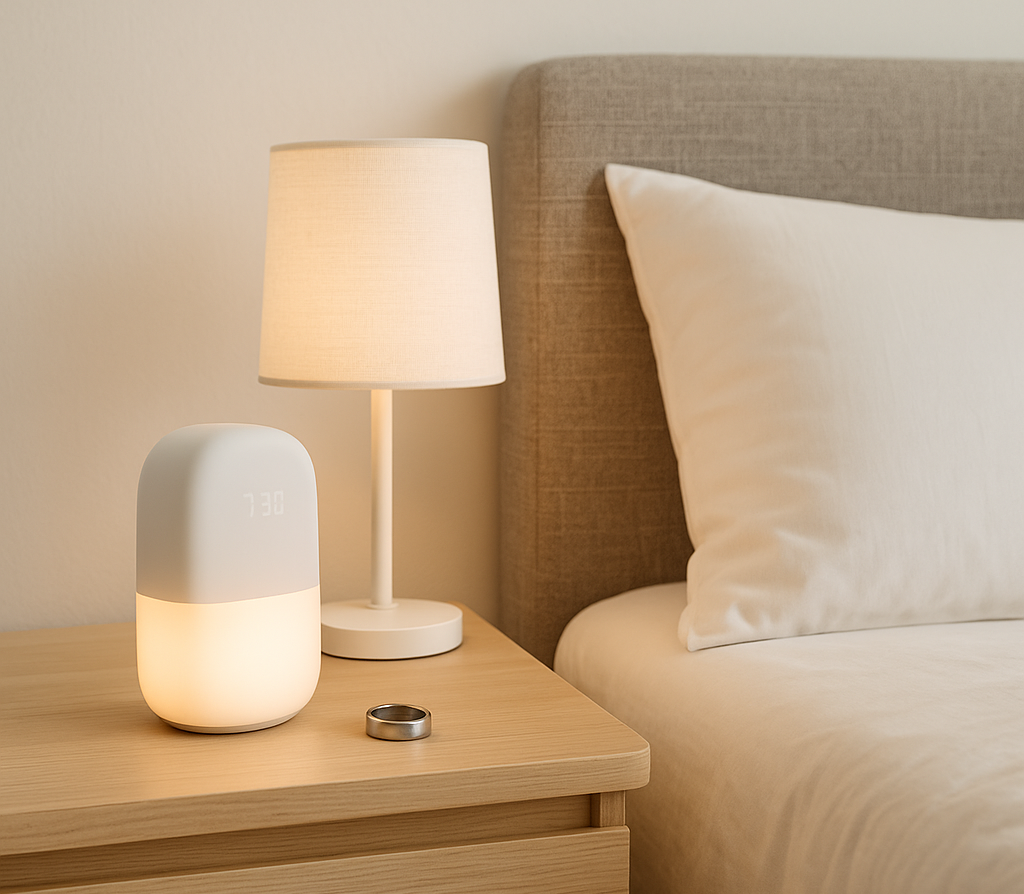
- → Oura Ring Gen 4 replaced Gen 3
- → Hatch Restore 3 updated the popular Restore 2
- → Muse S Athena emerged as the new premium brain-sensing tracker
- → Eight Sleep Pod 5 overtook Pod 3/4 in functionality
- → Therabody updated SmartGoggles to connect with wellness ecosystems
-
User Expectations Evolved
- → People now expect tech to adapt to their behavior — not just report data
- → There’s growing resistance to “quantified self perfectionism”
-
Integrations Deepened
- → Apple Health, Alexa, HomeKit, and Google Fit became central to routine syncing
- → Gadgets aren’t stand alone anymore — they’re part of sleep ecosystems
The Real Problems Sleep Tech Tries to Solve
Let’s strip it down to the root issues — because that’s where good sleep tech starts working.
Temperature Instability
The #1 underestimated sleep disruptor. Ideal range: 60–67°F.
If you overheat at night, deep sleep gets crushed.
What helps:
- Eight Sleep Pod 5 (AI climate control)
- Smart gel toppers
- Thermoregulating smart sheets
Stress & Anxiety
Sleep anxiety is now a wellness category. Obsessing over sleep metrics can backfire.
Meditation > optimization.
What helps:
- Hatch Restore 3 (wind-down soundscapes)
- Muse Athena (EEG biofeedback)
- Therabody SmartGoggles (pre-sleep parasympathetic activation)
Screen Time, Light, and Blue-Light Overload
Blue light blocks melatonin. Night scrolling = worse REM.
Risk of poor sleep quality increases by 1.32–2.12x
What helps:
- Sleep masks with blackout + circadian LED systems
- Smart lighting that dims with sunset
- Sunrise alarms to restore rhythm naturally
Environmental Noise
Noise doesn’t need to wake you to damage sleep. It fragments cycles.
What helps:
- White noise machines with adaptive sound
- Smart earplugs (with noise profiling)
- Alexa-automated ambient audio
The Gadgets We Trust (And Which Gen They’re In)
We’ve tested both the latest and prior models. Here’s what we recommend — and why.
Oura Ring Gen 4
Sleep Tracking + Recovery Analytics
Sleep stage accuracy up to 79.5%, readiness score backed by HRV, temp, and more
→ Best for users who want long-term feedback and smart alerts.
Still relevant: Gen 3 is available and functional — we reviewed it here
Hatch Restore 3
Sleep Onset + Gentle Wake-Up
Combines sunrise lighting, meditation, ASMR and bedtime audio — all screen-free after setup.
→ Excellent for people who use phones in bed and want to break that habit.
Still available: Restore 2 (our review here)
Eight Sleep Pod 5
Smart Bed Climate Control
Real-time AI temperature adjustments. Dual zones. Tracks HR and respiration too.
→ Best for hot sleepers and couples with different needs.
Muse S Athena
Neurofeedback for Sleep Preparation
EEG-powered headband that guides wind-down through brainwave biofeedback
→ Most effective for anxious, racing minds before bed.
Still emerging — but promising. We’re testing now.
Therabody SmartGoggles
Eye Relaxation & HR-Sync Therapy
Combines gentle pressure, vibration, and warmth for pre-sleep calm
→ Great for stressed professionals and screen-weary users.
Also still great:
- Logitech MX Master 3S: Perfect workday companion that reduces stress
- FlexiSpot E7: Excellent standing desk — Gen Pro also available (comparison coming soon)
- Muse S Gen 2: Still solid, but Athena now supersedes
| Device | Previous Gen | Current Gen | Status |
|---|---|---|---|
| Oura Ring | Gen 3 | Gen 4 | Both available |
| Hatch Restore | 2 | 3 | Both available |
| Eight Sleep | Pod 3 | Pod 5 | Pod 3 discontinued |
| Muse | S Gen 2 | Athena | Gen 2 still sold |
| Theragun Mini | Gen 2 | Gen 3 | Gen 3 current |
| FlexiSpot Desk | E7 | E7 Pro | Both active |
Sleep Ecosystems in 2025 (How They Sync)
Modern sleep tech doesn’t live in isolation. It integrates.
Apple Health & HomeKit
- Oura, Sleep Cycle, AutoSleep
- Automation: lights dim → blinds close → white noise starts
Alexa & Google Assistant
- Voice-controlled sleep scenes
- “Alexa, dim lights, start breathing sounds”
Google Fit & Wearables
- Muse syncs mindfulness + sleep logs
- Fitbit, Whoop, and others expand integrations
Why Sleep Tech Needs Science, Not Hype
Mental Health
Better sleep = better mood.
Meta-analysis of 8,600 people:
- ↓ Depression: -0.63
- ↓ Anxiety: -0.51
- ↓ Stress: -0.42
Aging & Circadian Disruption
1-year circadian disruption = +12% mortality
How to Choose What’s Right for You
Step 1 – Diagnose your sleep issue
Stress? Heat? Phones? Noise?
Step 2 – Set your budget
- $150 → smart lights, sleep masks, noise
- $150–$400 → trackers, alarms
- $500+ → smart beds, multi-device systems
Step 3 – Match your ecosystem
Apple Health? Alexa? Google? Don’t fight your setup.
Step 4 – Evaluate ROI
Ask: will this help me rest better, think clearer, live calmer?
Our Take on the Future of Sleep Tech
We don’t believe in perfectionism.
We believe in progress.
A better night’s sleep isn’t about hitting “100% deep sleep” or “7 REM cycles.”
It’s about waking up clearer. Feeling less chased. Restoring some of your rhythm.
Sleep tech can help — if it’s chosen carefully, used gently, and fits your life.
That’s what we recommend. With care.
Related Guides & Reviews
- → Oura Ring Gen 3 Review
- → Hatch Restore 2 Review
- → Theragun Mini 3 Review
- → Explore Our 2025 Top Smart Gadgets
References & Sources
- Research and Markets – Global Sleep Tech Devices Market Report (2025)
- NIH – Impact of Blue Light on Sleep Quality: Meta-Analysis
- NIH – Meta-analysis: Sleep and Mental Health Outcomes (2022)
- Nature – Circadian Disruption and Mortality: Digital Biomarker Study
- ZDNet – Best Smart Rings for Sleep and Health (2025)
- NIH – Oura Ring Accuracy Validation Study (2024)
- ZDNet – Hatch Restore User Experience (2025)
- CNET – Eight Sleep Pod 5 First Look